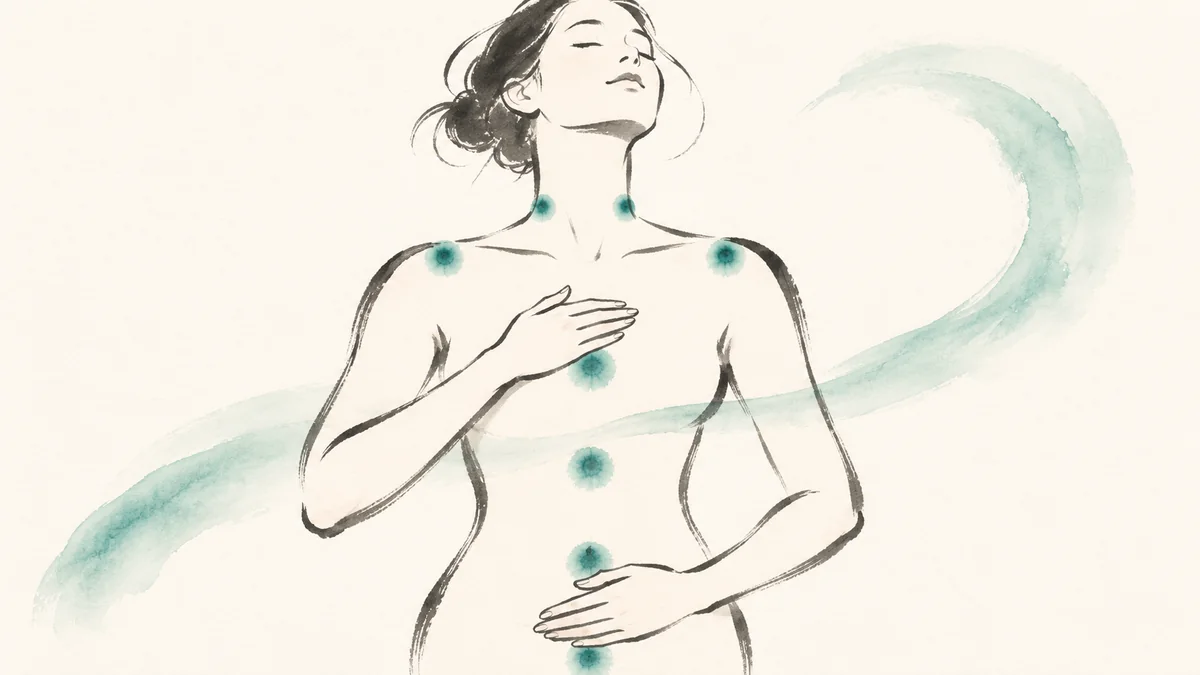
Most of us treat stress as if it were purely a thinking problem...
Something happening behind our eyebrows that we ought to solve with a better to-do list, a stricter schedule, or a stern pep talk.
Yet long before your mind admits you are overwhelmed, your body has already quietly dressed itself in muscular armour.
Where does stress actually live in the body?
Chronic stress, burnout, and unresolved grief settle into predictable physical holding patterns: clenched fingers and forearms, narrowed tunnel-vision eyes, locked back molars, a frozen breastbone, a knotted solar plexus, a rigid lower back, and curled toes at doorways.
Addressing the exact physical region with a 60-second somatic reset calms the nervous system faster than mental willpower alone.
This is why so many thoughtful, capable people feel frustrated when traditional advice to “just relax” falls flat. (If sitting motionless on a cushion actually makes your mind race harder, you will recognise the exact biology behind it in our companion guide on why sitting still makes overthinkers anxious.) You cannot argue a braced muscle into softness. You have to speak to your nervous system in the only language it truly trusts: warmth, breath rhythm, weight, and physical release.
Why Your Nervous System Keeps Score in Tissue, Not Thoughts
Your body does not brace itself out of malice or dysfunction; it braces out of an ancient, protective intelligence. When life demands more than you feel equipped to handle, your fascia and skeletal muscles act as biological shock absorbers. Your hands curl inward to hold a fragile world together by sheer friction. Your intercostal muscles lock beneath your ribs to keep unexpressed grief from stinging. Your lumbar spine transforms into an iron rod so that no sudden emotional gust can knock you off your feet. This physical armouring served a vital purpose when threat was acute and momentary, but in modern life, the threat rarely leaves the room.
The trouble begins when low-grade survival energy becomes your baseline operating system. Pushing through chronic tension keeps your autonomic nervous system locked in sympathetic overdrive. It burns metabolic fuel continuously, leaving you profoundly exhausted even after a full weekend of passive rest or sleeping late. Passive rest relaxes your calendar, but it rarely unhooks the subtle, subterranean contraction keeping your jaw clamped or your breath shallow. Your mind may be off the clock, but your physical tissues are still standing guard.
This is where 60-second somatic micro-resets alter the equation. Instead of demanding an hour of total quiet that your schedule cannot accommodate, a somatic reset meets your nervous system in the immediate present. You locate one braced physical zone in five seconds and offer it a direct, undeniable parasympathetic cue—warmth, mechanical decompression, or extended exhalation. By changing the physical input from the bottom up, you send an unambiguous safety signal straight to the brainstem, unhooking the alarm without requiring a single thought to change.
The 5-Second Body-Weather Diagnostic Map
Use this diagnostic map to identify where your body is currently storing unspoken pressure and discover the immediate physical intervention needed to release it.
Body ZoneWhat It Feels LikeWhat Your Body Is Guarding AgainstYour 60-Second Somatic Reset Hands & ForearmsFingers subtly curled, white knuckles, clutching phone or penTrying to hold a fragile life together by sheer gripThe Open-Hand Unclench Eyes & Base of SkullGritty eyes, narrow tunnel vision, dull ache at skull baseHypervigilant scanning for what might go wrong nextThe Dark-Soil Rest Jaw & ThroatClamped back molars, lump in throat, tight or strained voiceSwallowing unspoken emotion or forcing outcomesThe Hollow Reed Hum Chest & BreastboneShallow collarbone breaths, numb or heavy wooden sternumKeeping raw sorrow or panic sealed below the surfaceThe Sternum Thaw Pit of the StomachHollow knot, tight upper belly, sudden nausea or phantom hungerBracing around a loss or an unscripted futureSoftening the Gut Knot Lower Back & KneesLocked knees, stiff lumbar spine like an iron rodRefusing to bend or let anyone hold part of your weightThe Floating Spine Feet & DoorwaysCurled toes, held breath before opening emails or roomsPre-emptive bracing before stepping into the unknownThe Unmapped Step
Seven 60-Second Somatic Resets (From Your Hands to Your Heels)
Step 1: Hands & Forearms — The Open-Hand Unclench
- Turn both palms face-up on your lap or desk, letting your wrists rest fully supported.
- Slowly uncurl all ten fingers wide and flat, spreading them without straining.
- Close your eyes and imagine laying sharp, broken pieces down onto a solid, soft white-linen table, placing an inch of space between each item. Hold for three long exhales.
Anchor Whisper: “I stop crushing the shards in my fist. The table is strong enough to hold what broke, and my hands are allowed to rest.”
Step 2: Eyes & Skull Base — The Dark-Soil Rest
- Rub your palms briskly together for five seconds until you generate noticeable friction heat.
- Cup your hollowed palms gently over your closed eyes, completely blocking out light while ensuring no direct pressure rests on the eyeballs themselves.
- Allow your eyeballs to sink half an inch back into their sockets, taking six slow, unhurried breaths into the velvet darkness behind your hands.
Anchor Whisper: “Nothing is wasted in the dark. Something quiet is growing beneath my winter.”
Step 3: Jaw & Throat — The Hollow Reed Hum
- Rest four fingertips lightly on the centre of your breastbone.
- Part your back molars slightly, drop the root of your tongue away from the roof of your mouth, and widen the back of your throat as if beginning a gentle, closed-mouth yawn.
- Hum a low, effortless note on a long, slow exhalation until you feel a gentle vibration warming the sternum beneath your fingers. Repeat three times.
Anchor Whisper: “I do not need to force my way. I let the breath speak.”
Step 4: Breastbone & Upper Chest — The Sternum Thaw
- Press one warm, bare palm directly over your breastbone, placing your other hand on top of it.
- Inhale slowly sideways into your ribcage for five seconds, imagining your lungs expanding like a warm accordion.
- Exhale through softly parted lips for six seconds, feeling the wooden numbness behind your chest begin to soften into liquid warmth.
Anchor Whisper: “I trade dead numbness for living warmth. My chest is soft enough to feel, and strong enough to mend.”
Step 5: Solar Plexus & Gut — Softening the Gut Knot
- Rest your palms over the soft hollow approximately three inches below your breastbone.
- Consciously forbid your stomach from pulling inward on the breath in; allow your belly to round gently and freely into your waiting hands.
- Take three slow, spacious breaths, allowing the abdominal wall to expand on the inhale and drop completely heavy on the exhale.
Anchor Whisper: “I stop searching the floorboards for what is gone. I soften my belly, and I let new earth fill the rim.”
Step 6: Lower Back & Knees — The Floating Spine
- Soften the backs of your knees, unlocking them by just one inch if standing, or uncrossing your legs if seated.
- Visualise your spine as twenty-four light wooden beads threaded along a slack silk cord, floating effortlessly in warm salt water.
- Gently sway your ribcage half an inch to the left and right across three unhurried breaths, allowing ten per cent more of your physical weight to drop straight into your seat or heels.
Anchor Whisper: “I do not need to be made of iron to survive the water. I let the tide hold my weight.”
Step 7: Feet & Thresholds — The Unmapped Step
- Pause for ten seconds before opening a physical doorway, joining a video call, or lifting your laptop lid.
- Rotate your open palms slightly forward so your collarbones naturally widen and drop away from your ears.
- Direct three full breaths straight down into the soles of your feet, pressing your toes flat into the floor, and step forward across the threshold on your final exhale.
Anchor Whisper: “The map is burned. The ink is gone. I step into the unmapped day with a quiet heart.”
Matching Your Somatic Reset to Your Season of Life
Somatic awareness is not a one-size-fits-all prescription; it must adapt to the specific landscape you are currently navigating. Depending on your immediate life circumstances, physical tension may be signalling different emotional needs across our broader article ecosystem:
- Walking through heavy grief, life transitions, or deep personal loss? Read our deep dive on the 8 stages of Kintsugi grief and emotional wintering.
- Finding that workplace stress waits until midnight to bolt your eyes open? Explore horizontal somatic resets for 3:00 A.M. wakefulness.
- Absorbing everyone else’s anxiety in crowded offices or family settings? Learn how to stop absorbing other people’s moods without building a wall.
Frequently Asked Questions
Can stress really get “stuck” in specific muscles like the jaw or lower back?
Yes. When your autonomic nervous system perceives threat, it triggers automatic motor patterns—such as clenching your jaw to brace for impact or tightening your lower back to prepare for fight or flight. If the emotional or mental stressor remains unresolved, the brain maintains low-level motor unit firing in those exact muscles. Over time, this constant muscular bracing restricts local blood flow and fascia mobility, creating chronic physical tightness that persists long after the initial event has passed.
Do 60-second somatic exercises actually calm the nervous system, or do I need longer sessions?
Brief somatic resets are remarkably effective because the nervous system operates in real time based on sensory feedback. While deep structural change benefits from extended practice, a targeted 60-second intervention alters vagal tone immediately by changing mechanics: extending the exhalation, relaxing skeletal holding patterns, or applying warm tactile pressure. These physical shifts signal immediate safety to the brainstem, interrupting the physiological stress cascade in under a minute.
What if I feel an unexpected wave of emotion or tears during a somatic reset?
This is an entirely normal and healthy biological response known as a somatic release. When chronically braced muscles finally unclamp, the emotional energy that was being suppressed inside that physical contraction is released into your awareness. If tears or a deep sigh arise, do not fight them or try to analyse them intellectually. Keep your hands on your body, maintain a slow exhale, and allow the wave to pass through your tissues naturally.
How often should I practise somatic resets during a busy workday?
Rather than waiting until you are completely overwhelmed at the end of the day, aim for micro-interventions throughout your normal schedule. Practising a 60-second reset three to five times a day—such as before opening your inbox, after a challenging meeting, or when transitioning between work and home—prevents the cumulative buildup of sympathetic tension. Treating these micro-resets as natural boundary markers keeps your nervous system balanced throughout the entire day.
Every somatic reset in this guide comes directly from the worlds of Where the Bowl Broke (Book One) and Where the Ink Runs Out (Book Two) in The Sanctuary Series. You can explore both fables and the wider collection on our Books page.