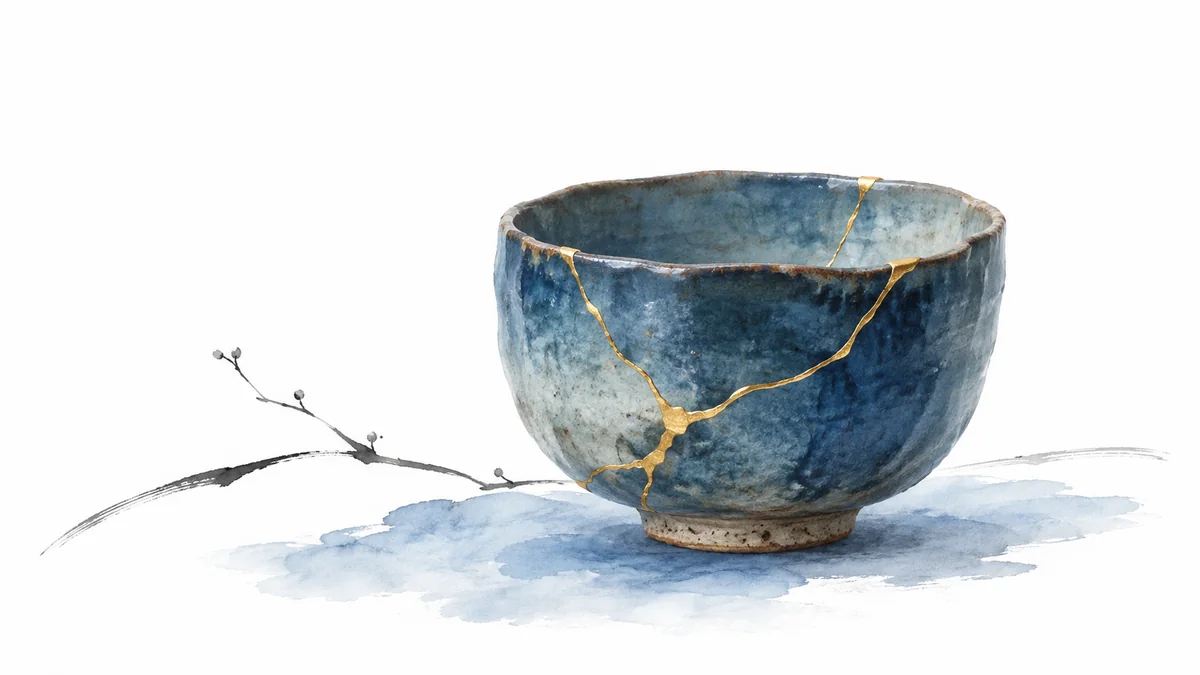
When something irreplaceable breaks in your life—whether through bereavement, the end of a long relationship, a sudden health shift, or the quiet collapse of a future you spent years building—the polite world around you usually offers one unspoken wish: that you look “good as new” as soon as possible.
What is Kintsugi grief? Inspired by the traditional Japanese craft of mending broken pottery with living lacquer and twenty-four-carat gold, Kintsugi grief rejects the pressure to hide your scars or “bounce back” quickly. Instead, it honours eight slow, body-first stages—from unclenching your hands and resting in emotional winter (Muro) to welcoming new life alongside old love (Yobitsugi)—so the places that broke become strong enough to hold warmth again.
For too long, we have treated grief as an exercise in invisible mending: gluing the edges back together in secret, painting over the cracks with bright cheerfulness, and walking through the supermarket holding our ribs stiff so nobody notices the pieces might rattle. Yet invisible glue only works on a dry show-vase sitting behind glass. The moment hot, living life touches a heart held together by brittle pretence, the seam gives way.
Why Grief Leaves Your Nervous System “Wired and Tired”
Modern grief culture is strangely rushed. It expects bright spring blossoms in the middle of December, demanding that you resume your routines, maintain your productivity, and display a calm face to the world before the shock has even cleared your bloodstream. When you force yourself to stay endlessly busy to escape the weight in your chest, your nervous system responds by locking into a continuous wired-and-tired state. This is a bone-deep cellular exhaustion paired with a restless, guilty hum whenever you attempt to sit still.
Consider the wisdom of a mountain plum tree. It does not apologise for dropping its leaves when the cold winds arrive, nor does it attempt to push out pink petals under a freezing sky. A fruit tree cannot bloom in April unless it has stood rooted in the dark, quiet chill of winter first. Emotional wintering is not a sign of weakness or clinical stagnation; it is the natural, biological requirement for inner restoration. Your body knows how to heal, but it requires cold, unhurried space to do so.
Grief does not just ache in memory—it hides physically in your hands, breastbone, solar plexus, and side-ribs. You can explore the full physical map in our guide to where stress actually lives in your body.
The Eight Traditional Stages of Kintsugi — Mapped to the Grieving Heart
In the classical workshop, a broken vessel is never rushed. Each phase of repair requires distinct materials, precise humidity, and immense patience. When we map these eight steps of craft onto the landscape of loss, grief ceases to be an enemy to defeat and becomes a sacred process of transformation.
Stage 1 — Hiroi (Gathering the Shards): Stop Being the Glue
In the immediate aftermath of loss, our instinct is to clutch sharp pieces against our chest with white knuckles, trying desperately to hold the structure of our lives together by force of will. Hiroi is the deliberate act of stopping. It means admitting that the bowl has broken and that your hands are exhausted from holding the edge.
60-Second Cue (The Open-Hand Unclench): Turn both palms face-up on your lap, uncurl all ten fingers wide, and imagine laying every shard onto a solid white-linen table with an inch of quiet air between each piece.
Stage 2 — Urushi (The Living Sap): Trading Dead Numbness for Living Warmth
Natural Urushi lacquer is harvested from the resin of the lacquer tree. Remarkably, the tree yields its sap only where its bark has been wounded. In grief, we often mistake our initial numbness for strength. Yet when tears finally break through, the sting is not rot or weakness —it is the living sap of how deeply you loved, rising naturally to mend the cut.
60-Second Cue (The Sternum Thaw): Press a warm bare palm flat over your breastbone and take three slow, wide accordion breaths straight into the centre of your chest.
Stage 3 — Sabi-urushi (The Missing Piece): Building New Earth Where Something Vanished
Even when you gather every surviving fragment from the floor, you will often find that a crucial piece turned to powder upon impact. It is gone forever. In Kintsugi, master artisans do not discard the vessel; they blend fine natural clay or wooden powder with Urushi sap to create Sabi-urushi, building a strong new foundation where the void opened.
60-Second Cue (Softening the Gut Knot): Lay warm palms over the tight hollow three inches below your breastbone and let your upper belly gently round outward on three slow inhales.
Stage 4 — Muro (The Cupboard of Waiting): Entering Emotional Winter
This is the central secret of the craft. Raw Urushi lacquer will never harden in a hot dry oven or under bright sunlight; it blisters and peels. It cures into an unbreakable bond only inside the Muro—a dark, cool, humid cedar cupboard. Emotional wintering is your personal Muro.
It is the quiet season where you withdraw from unnecessary demands, step away from social performance, and allow your heart to heal in the quiet dark where nobody demands a progress report.
60-Second Cue (The Muro Rest): Rest one hand softly across your forehead and the other warm over your lower belly, releasing a slow six-second exhale and whispering: “Nothing is wasted in the dark.” If you feel exhausted to the bone yet buzzing with restless guilt whenever you try to sit still, read our deep dive on why grief makes you feel “wired and tired” and the Muro cupboard reset.
Stage 5 — Togi (The Charcoal and the Tear): Putting Down the Dry Iron File
Once the mending paste has hardened, the seam is rough and raised. If a craftsman takes a harsh, dry iron file to the vessel, he will scratch and destroy the smooth porcelain glaze around the break. Instead, Togi relies on soft magnolia charcoal dipped continuously in clear water. Grief requires the same wet tenderness. Scraping your healing heart with harsh self-judgement—asking “Why aren’t I over this yet?”—only causes fresh injury.
60-Second Cue (The Water-Softened Seam): Touch two fingers gently to your throat, swallow slowly, blink three unhurried times to wet your eyes, and stroke softly across your collarbone.
Stage 6 — Fun-maki (The River-Gold): Unrolling the Hunched Apology
In this transformational stage, pure twenty-four-carat gold powder is scattered lightly across the wet lacquer seam. Kintsugi never paints gold over the untouched surfaces of the vessel—only along the lines of the original break. It lifts the fracture into plain sight, announcing that the history of the piece is its greatest beauty. You no longer need to walk with a hunched posture or offer a quiet apology for having suffered a heartbreak.
60-Second Cue (The Golden Seam Posture): Trace your fingertips outward along both collarbones, roll your shoulders up, back, and down, and lift your sternum gently toward the window.
Stage 7 — Yobitsugi (The Borrowed Shard): Healing the Isolation of Grief
When a piece of the original vessel is entirely lost, a master craftsman may perform Yobitsugi—joining a fragment from a completely different broken cup into the gap. The colours and patterns may not match, yet the resulting vessel possesses a striking, unexpected grace. Grief can isolate us, making us feel as though our old story is shattered beyond repair. Allowing new relationships, new places, or new creative passions into your life does not dishonour what you lost; it expands your container.
60-Second Cue (The Yobitsugi Reach): Place your palms on the outer sides of your ribcage with elbows soft and take three wide side-gill breaths into your hands.
Stage 8 — The First Pour (Boiling Water): Trusting Your Heart With Heat Again
A finished Kintsugi tea bowl is not meant to sit inside a display cabinet as a fragile museum piece. It is returned to the tea room. The true test of the cure occurs during the first pour of steaming water. Cured natural lacquer actually expands and bonds stronger when exposed to warmth. Healing is complete not when you are safe from life, but when you can open your heart to warmth, love, and connection once again without flinching.
60-Second Cue (The Warm Cup Breath): Cup your hands in front of your lower belly, soften your hips and pelvic floor downward on a five-second inhale, and let warm life reach the bottom of your cup without flinching.
A Simple 30-Second Morning Ritual for Your Winter Season
You do not need hours of complex meditation to support your body through emotional wintering. You only need small, consistent moments of somatic presence.
Every morning, when you prepare your warm mug of tea or coffee, pause before reaching for your telephone or looking at a screen. Wrap both bare hands firmly around the warm stoneware. Feel the heat transfer into your palms and wrists.
Part your back teeth slightly to release your jaw, widen your collarbones, and whisper this single intention aloud: “I no longer ask to be unbroken. The gold is in the seam, and my cup is full.”
If grief is keeping you awake in the small hours of the night, read our guide on why you wake up at 3:00 A.M. and horizontal somatic resets. If sitting with heavy feelings makes your mind race, try our body-first meditation resets for overthinkers. And if well-meaning people’s expectations are draining your energy, explore how to stop absorbing other people’s moods without building a wall.
Frequently Asked Questions
What does Kintsugi mean in grief and emotional healing?
Kintsugi is the traditional Japanese art of repairing broken pottery with natural lacquer dusted with powdered gold, silver, or platinum. In the context of emotional healing, it offers a philosophy that views loss and heartbreak not as flaws to be hidden or disguised, but as an essential, beautiful part of a person’s life history. Rather than attempting to return to your “pre-grief” self, Kintsugi grief encourages you to honour the mended seams as places of unique strength.
What is emotional wintering, and how long does it last?
Emotional wintering is a period of necessary rest, reflection, and quiet retreat following a significant life disruption or emotional trauma. Much like nature entering winter to conserve energy and prepare for future growth, wintering allows your nervous system time to recover from shock. Its duration varies for every individual; it cannot be rushed by external schedules or social expectations. Healing occurs when you stop resisting the dark season and grant yourself permission to rest.
Why does trying to “stay strong” after a loss leave me feeling numb?
Attempting to “stay strong” usually involves suppressing emotions, tightening your muscles, and remaining constantly busy to avoid feeling pain. This keeps your autonomic nervous system trapped in a prolonged fight-or-flight state, which eventually exhausts your adrenal resources and leads to a sense of emotional numbness or “wired-and-tired” fatigue. Numbness is your body’s defensive response to unexpressed grief and overload.
Does letting new joy into my life mean I am forgetting the person I lost?
No. In the craft of Kintsugi, adding new gold or incorporating a borrowed shard (Yobitsugi) does not erase the original vessel; it honours its history while creating a wider container. Experiencing new laughter, peace, or connection does not diminish your love for what was lost. Instead, it demonstrates that your heart has grown large enough to hold both old love and new life simultaneously. Walk all eight stages of the kiln alongside porcelain restorer Elena Ward and eighty-year-old master potter Sorin in Where the Bowl Broke: A Fable of Grief, Wintering, and the Golden Seam (Book One of The Sanctuary Series). You can explore Where the Bowl Broke and the full collection on our Books page.